
How to Backwash a Sand Filter, Step by Step
Updated
At a glance
Backwash a sand filter when its pressure is 10 to 12 psi above the clean-filter reading, when flow drops, or when the water stays cloudy (MSU Extension). Switch the pump off for every valve change, run Backwash for 2 to 3 minutes or until the discharge runs clear, then return to Filter and log the new pressure.
- Do the arithmetic
- Pool salt calculator Open the pool salt calculator
- Sources
Checked on ; next check .
On this page
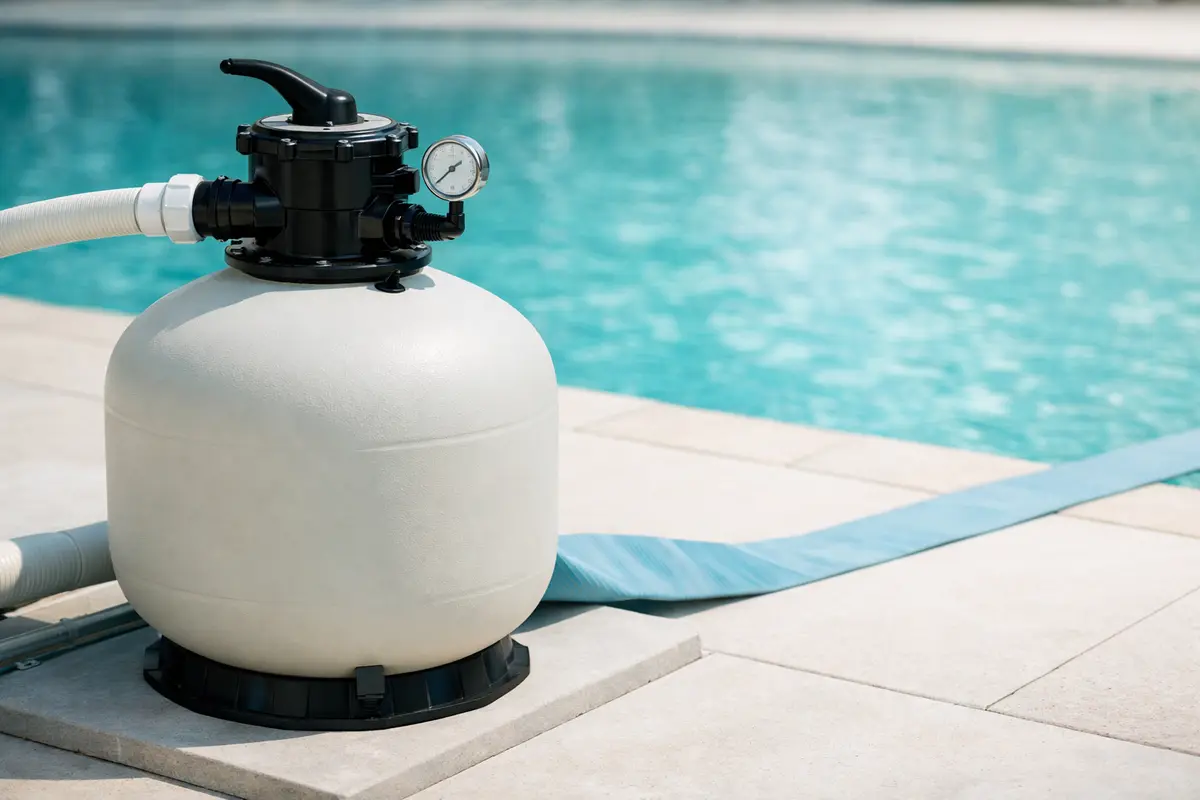
Backwashing reverses the water through a sand filter so the dirt trapped in the sand washes out of a waste line instead of back into the pool. It takes a few minutes, it costs some water, and done at the right time it is most of what a sand filter needs. This guide covers when to do it, the valve sequence, how long to run it and what to check once it's done. It follows Michigan State University Extension's manual for training pool operators, and it assumes a high-rate sand filter with a multiport or push-pull backwash valve and a pressure gauge on the tank. Cartridge filters have no backwash, and D.E. filters need recoating afterward, so for those see the pool filter troubleshooter.
When a sand filter needs a backwash
MSU Extension gives three signs, and any one of them is enough:
- the incoming pressure is 10 to 12 psi greater than the pressure on a clean filter;
- the flow has dropped because the dirty filter resists it;
- the pool water is cloudy and debris stays in it.
The first sign only works if you know the clean reading. Note the gauge right after a good backwash, with the pump at its usual speed, and keep that number. A calendar date is a poor substitute: a filter after a windy week or a pool party loads up far faster than one in a quiet month, and backwashing a filter that is only lightly loaded throws away water and, in a salt or stabilized pool, the chemicals dissolved in it.
Worked example: a filter 10 psi over its clean reading
A sand filter read 12 psi after its last backwash, and that reading is written in the note on a pool chemistry log entry. Two weeks of leaf fall later, the gauge says 22 psi. That is 10 psi over clean, the bottom of MSU's 10 to 12 psi band, so the filter is due. The pump goes off, the valve goes to Backwash, and the pump goes back on. The sight glass on the waste line runs brown, then lightens, and after about two and a half minutes it runs clear. The pump goes off again for a short run on Rinse, then off once more while the valve goes back to Filter. The gauge settles at 13 psi, close to the old baseline, so the sand cleaned up well. The pool uses a salt chlorinator, so the salt reading is checked the next day, since the water sent to waste took salt with it.
The sequence, with the pump off between moves
- Switch the pump off. Never turn a multiport handle with the pump running. MSU's instructions for filter valves are to stop the pump when changing valves, and never to close all the valves at once, which can damage the pump or the filter.
- Make sure the waste line can discharge where it is allowed to (see below), with any hose rolled out and the outlet clear.
- Set the valve to Backwash and seat the handle fully. A handle that stops between positions lets water and sand go where they shouldn't.
- Switch the pump on and run it for 2 to 3 minutes, which is MSU's recommended time for a high-rate sand filter, or until the discharge runs clear. If the filter has a sight glass, watch it; otherwise watch the end of the hose.
- Switch the pump off, then rinse if your valve has a Rinse setting. Set the valve to Rinse and run the pump briefly. A rinse resettles the sand bed and sends the loosened dirt still above it to waste, so the first water back to the pool isn't cloudy. Follow the valve's own manual for its length.
- Switch the pump off, set the valve to Filter, and restart. MSU calls this the filter run position.
- Read the gauge and write it down. That number is the new clean baseline.
Where the backwash water goes
Backwash water is pool water with the filter's dirt in it, and it carries chlorine, stabilizer and, in a salt pool, salt. Where it may go is set locally. MSU's winterizing steps send backwash to waste as approved by the local municipality, which may mean the sewer, a storm drain or another approved area. Check with your city or county before running a hose to a street drain, a neighbour's yard or a garden bed.
What a backwash does to the water
Backwashing replaces water, and that changes a few readings. The Hayward AquaRite manual lists backwashing alongside splashing and draining as the ways a salt pool loses salt, so test salt after a long backwash and use the pool salt calculator if it has fallen. The same water loss works in your favour with stabilizer: PHTA's cyanuric acid bulletin lists longer or more frequent backwashing among the ways to lower CYA, since nothing added to the water removes it.
Signs the sand itself needs attention
Short runs between backwashes, sand in the pool and a gauge that won't come back down are the signs to look further. MSU explains that the sand sits around a set of finger-like laterals at the bottom of the tank, with an open space of 12 inches or more above it, called the freeboard, so the sand can tumble and loosen during a backwash. Sand arriving through the pool's inlets means a cracked or broken lateral, or a backwash lever not properly set in place. When MSU's winterizing steps open the tank to inspect the sand, the sand should not be channeled or cemented together and should hold no mud balls or calcified chunks; if it does, it is treated with a filter-cleaning product used as its maker directs, or changed. Opening a tank and replacing sand or laterals is best left to a pool service technician if you haven't done it before. A pump that loses prime during or after a backwash is covered in the pump not priming troubleshooter.
Sources (3)
Get new tools by email
When we add a tool to Pool Chemical Log, we'll send you one short email. Nothing else.