
How to Clean a Salt Cell: Inspect, Rinse, and Acid Wash Only if Needed
Updated
At a glance
Clean a salt cell only when it shows scale or debris: power off, release the pressure, hose it out, and acid wash only what the hose leaves. Mixes differ: 1 part acid to 4 of water (Hayward, Pentair, Jandy) or 1 to 10 (CircuPool), soaked from a few minutes up to 30 at most.
- Do the arithmetic
- Pool LSI calculator Open the pool lsi calculator
- Sources
Checked on ; next check .
On this page
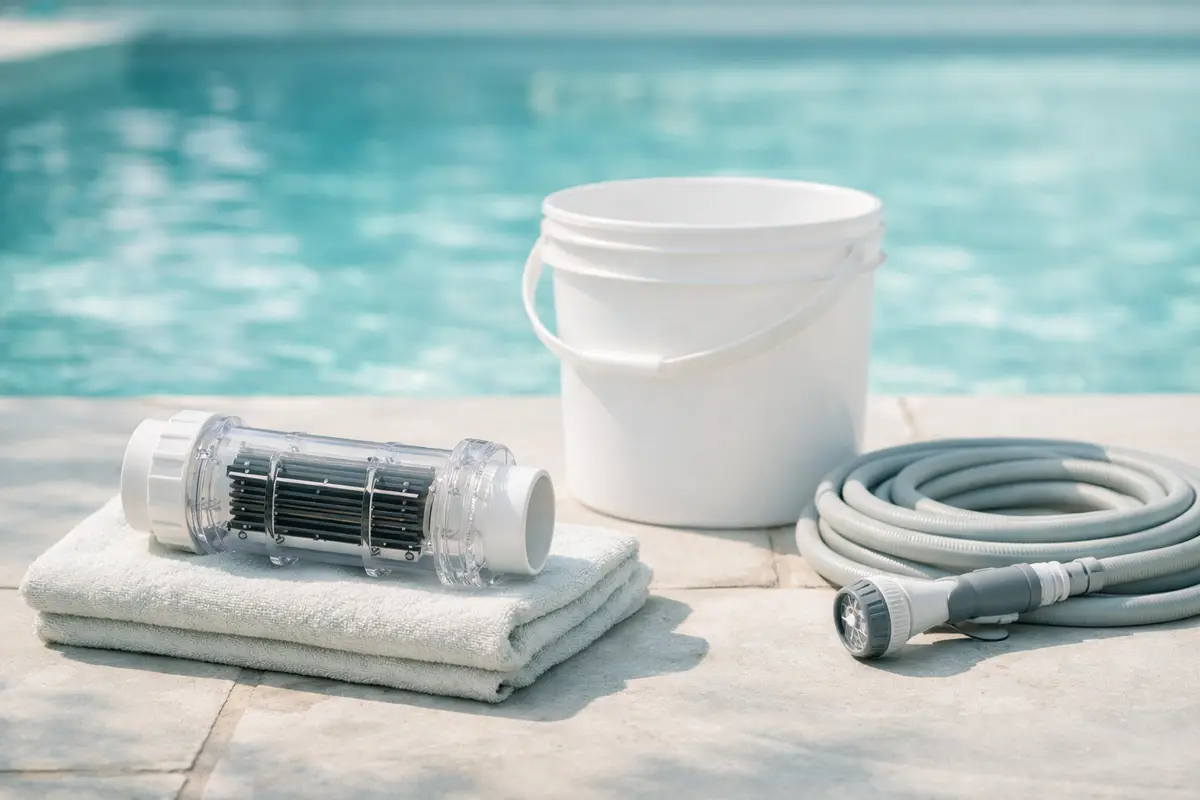
A salt chlorine generator makes chlorine on a stack of coated titanium plates, and anything that coats those plates, mostly white calcium scale, cuts its output. Most cells have a self-cleaning cycle that reverses their polarity to shed scale, so cleaning by hand is an occasional job, done when the generator asks for it or an inspection shows a build-up. This guide covers how to inspect a cell, the gentle cleaning to try first, the acid wash for what's left, and why the cell scaled in the first place. It draws on the manuals for four common generators: the Hayward AquaRite 900, Pentair IntelliChlor, Jandy AquaPure and CircuPool CORE. Where they differ, and on acid they do, follow the manual for your own cell.
When to look inside the cell
Each maker sets its own schedule. Hayward recommends opening and inspecting the cell every 3 months or after cleaning the filter, and the AquaRite flashes its Inspect Cell light after about 500 hours as a reminder. Jandy suggests checking a new installation once a month for several months, then, if it stays clean, once at the end of each season. Pentair says to inspect every two months if the cell tends to scale, more often in hard water, and at least twice a year even when it stays clean. CircuPool's cell turns on a Clean Cell light when the plates need attention.
A light alone doesn't mean an acid wash. It means look.
Worked example: a cell with a light crust
A Pentair cell has been running for two months when its two-month inspection comes due. With the power off and the pump stopped, the cell comes out, and looking through it shows a thin white crust on the blades and a few leaves caught at one end. A jet from a garden hose, aimed into both ends, clears the leaves and most of the crust, which has the slushy feel Pentair describes. A faint film is left between the blades, so the cell gets an acid wash: Pentair's mix of one quart of muriatic acid in one gallon of water, acid poured into the water, then into the capped cell until the blades are just covered. It foams hard for about twenty minutes and then stops, well inside Pentair's thirty-minute limit. After a thorough rinse the blades are clean. Since the cell needed acid, the next step is a water test, because scale this quick points to water that is out of balance.
Before you start: power, pressure and protection
- Switch off the generator's power and the pump. CircuPool's steps start by turning off all pool equipment, disconnecting the unit and closing supply valves where fitted. Pentair also disconnects the cell's cable at its power center.
- Release the system pressure. Jandy warns that the pump and filter run under pressure, which has to be released before anything is removed; open the filter's air relief valve.
- Keep the electrical end dry. Hayward has the acid stop just below the wiring compartment, and CircuPool says to cap the connector and, if it does get wet, rinse it at once with fresh water, then with rubbing alcohol, and let it dry thoroughly.
- Wear rubber gloves and eye protection, and work in fresh air. All four manuals say to add acid to water, never water to acid.
Step one: hose and scrape before any acid
Look through the cell for scale, which Hayward describes as light-colored crusty or flaky deposits, and for debris that has slipped past the filter and lodged between the plates. If it's clean, put it back. If not, try a high-pressure jet from a garden hose first. Pentair notes that most of the build-up is slushy and blows out, which also makes any acid wash that follows more effective. Hayward allows a plastic or wooden tool to scrape deposits off, but never metal, which scratches the plates' coating; CircuPool goes further and says to insert nothing hard into its cell at all, and that doing so voids the warranty.
Step two: the mild acid wash, at your maker's ratio
Use acid only for what the hose couldn't move. The four manuals disagree on the mix and the time, and the difference matters, because Jandy and Pentair both warn that too much acid washing damages the cell:
- Hayward: 4 parts water to 1 part muriatic acid, which it gives as one gallon of water to one quart of acid. It calls this for severe cases only. Soak for a few minutes, then rinse with a high-pressure hose.
- Pentair: one quart of muriatic acid with one gallon of tap water, poured into the cell with its cleaning-kit cap until the blades are just covered. Leave it until the foaming stops, and never more than thirty minutes.
- Jandy: one pint of muriatic acid with two quarts of tap water, poured into the cell with its ports plugged. Leave it until the foaming stops, but not longer than half an hour.
- CircuPool: one part muriatic acid into ten parts water, enough to cover the blades. Wait for the foaming to stop, and soak for no more than fifteen minutes.
The foaming is the scale, calcium carbonate, dissolving. Jandy and Pentair both say that if vigorous foaming doesn't start, the cell doesn't need acid at all, so stop there. Afterward, rinse the cell thoroughly with clean water and look again; repeat only if deposits remain. Dispose of the used solution as the acid's label and your local rules direct, never into the pool. Hayward's AquaRite also wants its diagnostic button held for 3 seconds after an inspection to restart its reminder timer.
Why the cell scaled, and how to slow it
Scale on a cell is a water problem showing up on the equipment. Hayward reads a build-up as a sign of unusually high calcium, with old pool water the usual cause. Pentair recommends a water test for calcium hardness and balance whenever an acid wash was needed, and gives its ideal hardness as 200 to 400 ppm. CircuPool ties fast scaling to a saturation index that stays high. The pool LSI calculator shows which way your water leans, and the ideal levels chart sets out the ranges.
If the warning comes back
If the light returns soon after a thorough cleaning, CircuPool says to verify the salt level and clean again, and Hayward says a cell whose inspection light stays on after a proper cleaning may be worn out and need replacing. The salt cell troubleshooter works through flow, salt and temperature warnings, and the pool salt calculator sizes a top-up. A cell that keeps failing, or a power center showing faults, needs a pool service technician, with a licensed electrician for any wiring.
Sources (4)
- Hayward, AquaRite 900 manual hayward.com
- Pentair, IntelliChlor IC15–IC60 installation and user's guide pentair.com
- Jandy, AquaPure PureLink manual (H0325600) jandy.com
- CircuPool, CORE series manual circupool.com
Get new tools by email
When we add a tool to Pool Chemical Log, we'll send you one short email. Nothing else.