
How to Vacuum a Pool by Hand: Setup, Strokes, and Filter or Waste
Updated
At a glance
Fill the vacuum hose with water before it meets the skimmer so the pump keeps prime, then work in slow, overlapping strokes. Send dead algae and settled floc to waste, and never vacuum feces or vomit: the MAHC 2024, a public-pool code, bars it unless the waste reaches a sanitary sewer.
- Do the arithmetic
- Pool chemical calculator Open the pool chemical calculator
- Sources
Checked on ; next check .
On this page
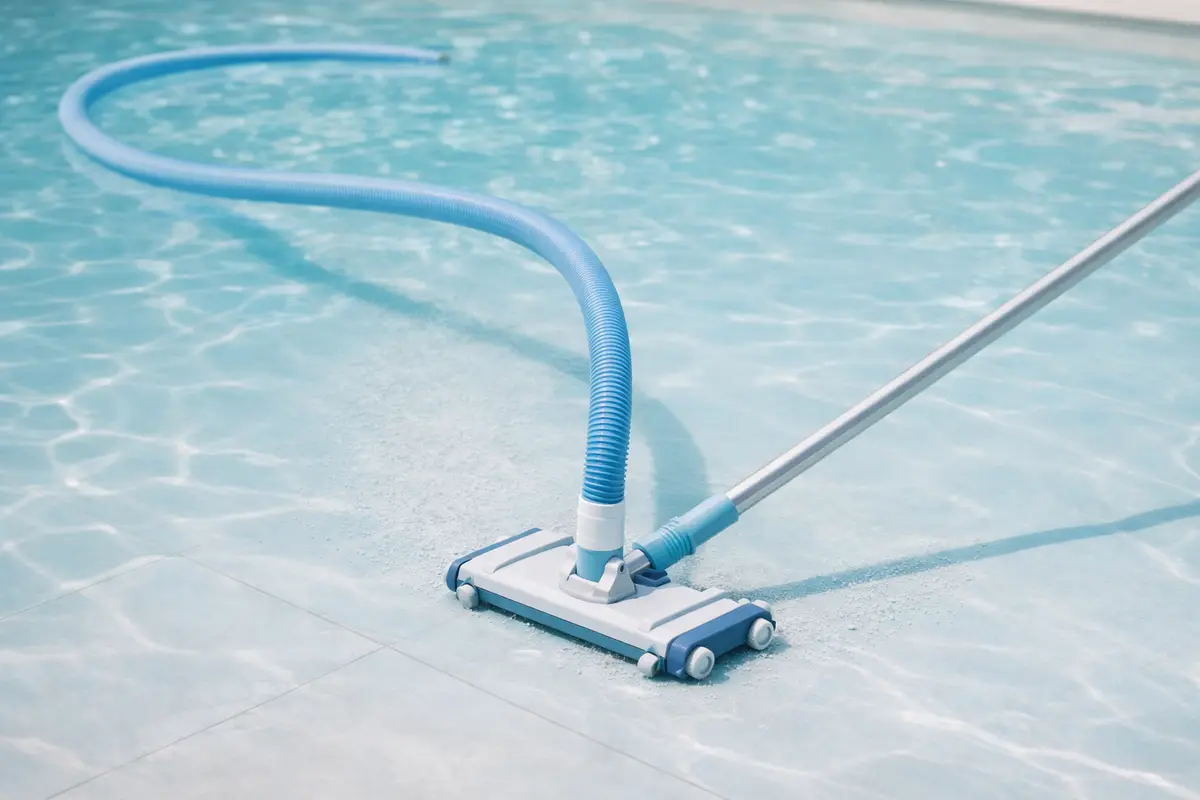
A manual pool vacuum is a weighted head on a telescopic pole, connected by a floating hose to the skimmer, so the pool's own pump does the sucking and the filter catches what comes up. It picks up what the skimmer and the filter's normal flow can't: leaves that have sunk, grit along the floor, dead algae after a shock and anything a clarifier has settled out. This guide covers setting up so the pump doesn't lose prime, how to work the floor, when to send the water to waste instead of the filter, and the one thing a pool vacuum should never pick up. It is written for a home pool with a skimmer and a sand, cartridge or D.E. filter. Robotic and suction cleaners work differently; follow their own manuals.
Why vacuuming matters
Michigan State University Extension's pool manual, a training text for pool operators, lists brushing or vacuuming pool surfaces frequently among the habits that keep algae from taking hold, and it treats debris on the floor as a cause of short filter runs: its fix for a sand filter that clogs fast includes screening off floating particles and vacuuming settled material. Algae treatment depends on it too. The EPA-registered label for a calcium hypochlorite shock gives these directions after an algae treatment: "Thoroughly clean pool by brushing surface of algae growth, vacuum and cycle through filter."
Worked example: a floor of dead algae after a shock
A pool cleared from green has turned a dull grey-blue, with a fine grey-green dust lying on the floor. The water above it is clearing, the free chlorine is still holding, and the filter on this pool is a sand filter with a multiport valve. The dust is dead algae, fine enough that a sand filter would pass some of it straight back into the pool, so this is a vacuum-to-waste job. The water is topped up first, an inch or two above normal, to allow for what will go out of the waste line. With the pump off, the valve goes to Waste. The vacuum head and pole go in, the hose is filled until no more bubbles come out of it, and its end is pushed into the skimmer's suction port. Pump on. Slow, overlapping passes from the shallow end toward the deep end lift the dust without clouding the water, and the pump is switched off once to top the pool up again halfway through. When the floor is clean, the pump goes off, the valve goes back to Filter, and free chlorine and pH are tested again, since the refill has diluted them. Both readings and the top-up go into a pool chemistry log entry.
Setting up so the pump keeps its prime
The pump has to keep pulling water, not air, all the way through. A hose that goes on full of air sends a slug of it to the pump, which can lose prime and run dry.
- Check the hose. MSU says the vacuum hose must be in good repair and replaced if it has holes. A split lets air in on every stroke.
- Empty the skimmer and pump baskets so the pump starts with full flow.
- Assemble the head and pole and lower the head to the floor, with the hose attached to the head.
- Fill the hose with water. Feed it down into the pool from the head end until no more bubbles come out of the free end, or hold the free end against a return jet until water pours from the head.
- Connect it at the skimmer with the end kept under water, either straight into the suction port or through a vacuum plate on top of the skimmer basket. If the skimmer has two openings, the suction from the pump must be strong enough through the one you use; MSU notes that a weak skimmer suction may need the lines cleared.
If the pump fills with air anyway, switch it off, refill its strainer pot and start again; the pump not priming troubleshooter covers what else to check.
How to work the floor
Move the head slowly, the way you would mow a lawn, in straight passes that overlap a little. Fast strokes lift the fine material into the water instead of into the head, and it settles again an hour later. Start at the shallow end and work toward the deep end, and do the walls and steps last if they need it. Watch the skimmer or pump basket on a leafy day: once it fills, suction drops, so stop, empty it and refill the hose before carrying on. Brush before you vacuum if anything is stuck to a surface, since a vacuum lifts what is loose and leaves what is attached.
Filter or waste
Ordinary leaves, grit and bugs can go through the filter, which is its job. Two things are better sent to waste, straight out of the system, on a filter with a Waste setting: fine dead algae after a shock, and anything a flocculant has dropped to the floor. Both are so fine that a filter either passes them back to the pool or clogs at once. Vacuuming to waste drains water as it goes, so top up first, keep the hose running into the pool while you work, and test chlorine, pH and, in a salt pool, salt afterward. A cartridge filter has no Waste setting; vacuum slowly and clean the cartridge when you finish. After a big clean-up on a sand filter, a backwash is usually due; see how to backwash a sand filter.
What never to vacuum
Feces and vomit stay out of the vacuum. The MAHC 2024, a public-pool code, puts it this way: "Aquatic vacuum cleaners shall not be used for removal of contamination from the water or adjacent surfaces unless vacuum waste is discharged to a sanitary sewer and the vacuum equipment can be adequately disinfected."
According to the MAHC Annex, guidance for public pools, the vacuum itself becomes contaminated, and the code's authors know of no manufacturer with a way to disinfect one afterward. A home pool isn't bound by that code, but the reasoning holds. Scoop or net the material out instead and follow the pool poop accident checklist.
When it isn't working
If the floor is clean and the water is still cloudy or green, the problem is in the water, not on the floor; start with the green pool guide. A pump that won't hold prime, a filter whose pressure climbs within a day, or a cracked skimmer housing is a job for a pool service technician.
Sources (4)
- Michigan State University Extension, Swimming Pool Pest Management, Category 5A manual canr.msu.edu
- EPA Reg. No. 1258-1239, HTH Granular 73 calcium hypochlorite label (2025) www3.epa.gov
- CDC, Model Aquatic Health Code, 2024 (5th edition): Code, a public-pool code cdc.gov
- CDC, Model Aquatic Health Code, 2024 (5th edition): Annex, guidance for public pools cdc.gov
Get new tools by email
When we add a tool to Pool Chemical Log, we'll send you one short email. Nothing else.